The core route is simple: choose a dress design or fabric, cut the pattern pieces from the fabric, and sew the pieces together for a customer or townsfolk. The official descriptions also make clear that the finished result can be used to satisfy—or sabotage—the person requesting it.
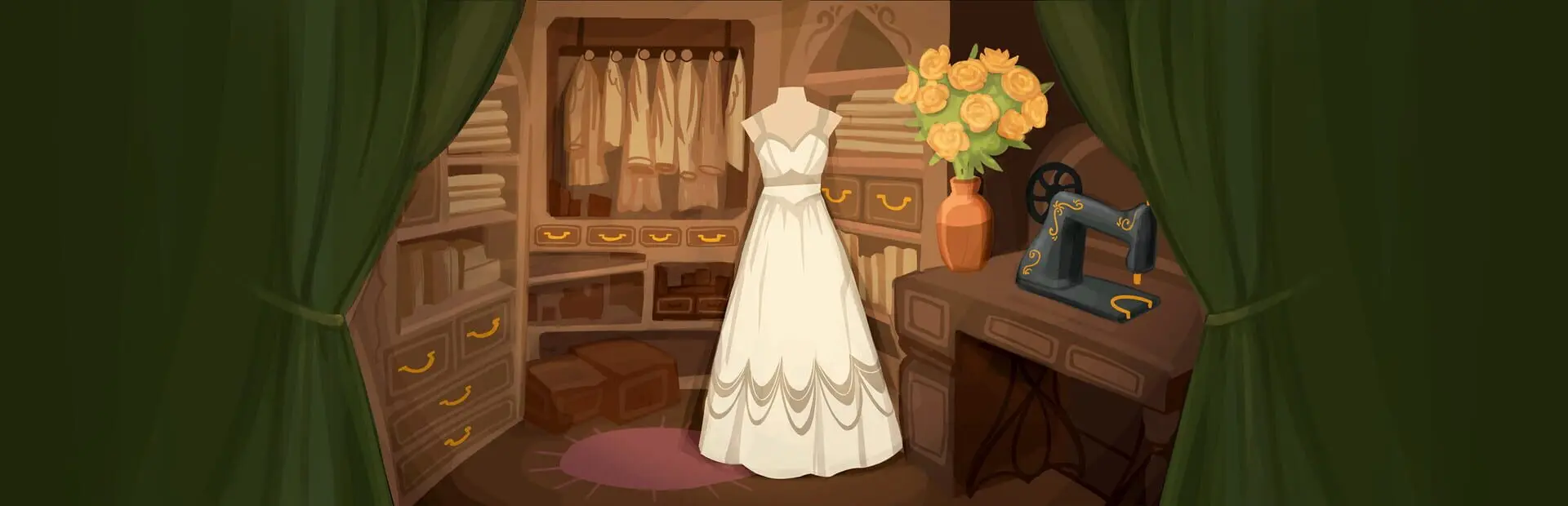
The complete dressmaking loop
The confirmed gameplay information describes three connected steps rather than a separate combat, exploration, or resource system. Fabric selection comes first, followed by pattern cutting, and then sewing. Treating the work as one sequence makes the guide easy to follow: make the material choice, prepare the pieces, and assemble the dress.
| Stage | What the available descriptions confirm | What to focus on |
|---|---|---|
| Choose | Pick a dress design or choose fabric before making the garment. | Read the request and decide what you are trying to make. |
| Cut | Cut the pattern pieces from the selected fabric. Cut fabric is shown as being added to the inventory in the Steam media description. | Check that the pieces are prepared before moving on. |
| Sew | Sew the selected and cut components together into a dress. | Follow the sewing task carefully until the garment is assembled. |
| Deliver or judge | The stated goal is to satisfy or sabotage customers or townsfolk. | Treat the completed dress as the result of the choices made earlier. |
The official store and developer descriptions agree on this broad order. They describe a cozy crafting experience inspired by real dressmaking, so the useful beginner habit is to finish one stage before making assumptions about the next. The available material does not specify a universal best fabric, a fixed customer table, or a single correct design for every request.
Choosing a design and fabric
The developer description says that players choose dress designs, while the Steam description emphasizes choosing fabric. Those statements fit together as the first decision in the loop: identify the garment you want to make, then select the material needed to begin preparing it. The sources do not provide a complete catalog of designs, fabric properties, prices, or customer preferences, so those details should not be treated as confirmed rules here.
Start with the request in front of you and keep the first decision narrow. If the available screen presents a design choice, select the intended design before cutting; if it presents fabric first, make the material choice and continue through the same preparation flow. This keeps the confirmed sequence intact without assuming that a particular fabric type always produces a better result.
What is and is not confirmed
The following points are supported by the supplied official descriptions:
- You choose a dress design or fabric as part of the opening step.
- The game is inspired by real dressmaking.
- The completed work is made for customers or townsfolk.
- The broader objective can be to satisfy or sabotage them.
The supplied material does not establish exact bonuses for cotton, linen, wool, silk, or velvet. It also does not establish a universal ranking of fabrics, a fixed shopping route, or a complete customer-preference chart. Use those as questions to verify in a current build rather than as rules to memorize.
Cutting pattern pieces
After the initial choice, the next confirmed action is cutting the pattern pieces from fabric. The Steam media description says that cut fabric is added to the inventory, which indicates that cutting prepares usable components for the later sewing step. In practical terms, this is the point where the selected material becomes the set of pieces you will assemble.
The supplied sources do not give a complete cutting-room control list or a confirmed universal placement rule. A third-party guide reports that pattern pieces should be aligned with the grain line and that the game may show a green outline for a correct placement, but that report is not an official description. It is safer to use the visible feedback in your current version and avoid treating an unlisted control or quality cap as a guaranteed rule.
A careful cutting routine
Use this short routine whenever you reach the cutting step:
- Confirm that the intended design and fabric are still selected.
- Place or position the required pattern pieces using the feedback shown by the current build.
- Cut the pieces before moving to the sewing stage.
- Check the inventory or preparation state if the game presents one, since the official media description shows cut fabric being added there.
This routine does not require a claimed score threshold or an invented material bonus. It simply follows the order supported by the sources and leaves room for version-specific interface feedback.
Sewing the dress together
Sewing is the final confirmed production step: the selected and cut components are sewn together to make a dress. The sources describe this as the point where the prepared pieces become a garment for a customer or townsperson. If the result is not what you wanted, review the earlier design, fabric, and cutting choices instead of assuming that the sewing stage alone determines everything.
The available official material does not list a complete keyboard map, a timing system, a score formula, or a guaranteed quality target. A third-party guide describes using the Space bar and arrow keys while sewing in prototype 0.5.5, but the supplied official descriptions do not confirm that control scheme. Check the controls shown by the build you are playing before relying on a specific key combination.
Avoiding unsupported assumptions
Some search topics commonly associated with a sewing guide are not fully documented in the supplied material. There is no confirmed table for customer satisfaction, no complete accessory catalog, and no official list of every sewing mistake or recovery action in the sources used here. The reliable advice is therefore procedural: complete the design choice, cut the pieces, sew them together, and judge the outcome against the customer or townsfolk goal presented in the game.
Customer goals and outcomes
The official wording gives the player an unusual choice of purpose: the dress can be made to satisfy or sabotage townsfolk or customers. That is a confirmed framing for the activity, but the material does not define every consequence of either choice. It does not provide a complete relationship system, reward table, evaluation formula, or list of requests.
For a first attempt, use the request or scene shown by the game as the immediate target. Make a clear fabric and design choice, finish the full cutting step, then sew the prepared pieces before evaluating the result. If the game offers a deliberate way to work against the customer, treat that as an in-game objective rather than assuming that every low-quality or mismatched garment automatically counts as sabotage.
Input and accessibility
Steam lists three accessibility features: Custom Volume Controls, Playable without Quick Time Events, and a Mouse Only Option. For players who prefer pointer-based input or who want to avoid timed input, those listings are the most direct confirmed guidance available in the supplied material. The presence of the mouse-only option means the game provides an input route that does not require a standard keyboard-and-mouse combination.
The developer has also stated in a Steam Community reply that the game was tested on Steam Deck and runs smoothly there, but does not currently support controllers. The same reply says controller support will be considered after launch. Steam Deck performance and controller support are therefore separate questions: smooth play on the device does not mean that a gamepad is supported.
| Question | Confirmed answer |
|---|---|
| Can it be played with mouse-only input? | Steam lists a Mouse Only Option. |
| Can quick-time events be required? | Steam lists Playable without Quick Time Events. |
| Are custom volume controls listed? | Yes, under Steam accessibility features. |
| Does it currently support controllers? | The developer reply says it does not currently support controllers. |
| Does it run on Steam Deck? | The developer says it was tested and runs smoothly. |
Prototype and version context
The developer's itch.io page identifies the downloadable prototype as version 0.5.5. The prototype was initially made by Free Lives in about three weeks, followed by another month or two of work, and the developer describes it as containing unfinished seams and ideas left out during development. The same page says work is continuing on a full version.
The supplied hotfix notes document several prototype changes and fixes. Hotfix 0.5.3 addressed trim placement, added more mannequin-scene camera controls using middle-click zoom, fixed a green trim issue, adjusted the ruffle skirt, added needle and pin models, fixed some patterns not fitting in the cutting room, fixed sketchbook paging while the pencil was selected, and added Argyle wool fabrics, red silk fabric, and a Gothic Collar pattern. Hotfix 0.5.5 fixed an incorrect flounce-sleeve sprite and corrected the ruffle-skirt grainline and naming.
The 0.5.5 notes also record a known save-order issue affecting existing ruffle skirts after the fix; new ruffle skirts were described as unaffected. They list prototype downloads for Windows, Linux, and OSX, with the Windows archive at 115 MB, Linux at 127 MB, and OSX at 128 MB. These notes describe a prototype state, so a later build may handle the same systems differently.
Printing patterns in real life
The supplied media summary reports that the patterns cannot be printed for real-life use. The in-game pattern pieces are therefore part of the digital dressmaking activity, not confirmed printable sewing templates. If your goal is to make a physical garment, use a real sewing pattern source rather than treating an in-game layout as a production-ready pattern.
Quick reference
- Start: choose a dress design or fabric.
- Prepare: cut the pattern pieces from the fabric.
- Assemble: sew the cut components together.
- Goal: make the result for a customer or townsperson, with the stated option to satisfy or sabotage.
- Input: Steam lists mouse-only play and play without quick-time events.
- Controller note: the developer says controller support is not currently available.
- Prototype note: the supplied itch.io page identifies version 0.5.5 and says a full version is in development.
- Codes: None are provided in the available material.
This is the complete confirmed route available from the supplied sources: choose, cut, sew, and evaluate the result in the customer or townsfolk context shown by the game. Details such as exact scoring, a full control map, fabric rankings, and every customer preference need a current source before they can be added as firm instructions.